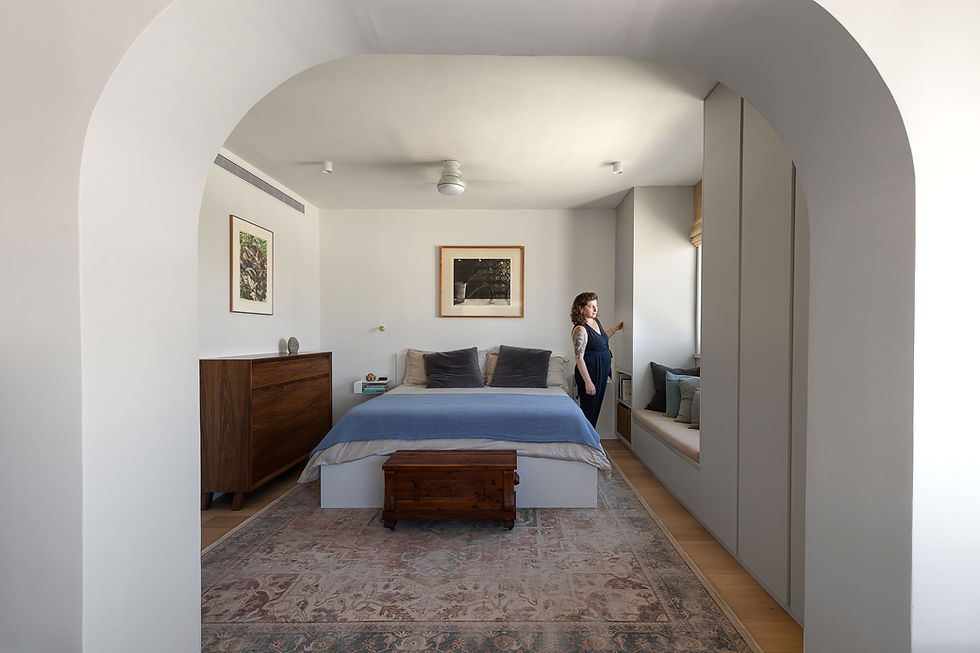
From generic to bespoke - Designing a new apartment in Israel

Updated: Aug 12
Buying a new apartment in Israel seems like a convenient, move-in-ready solution, yet development project standards only set a minimal baseline: layouts and technical specifications are designed for an abstract buyer, and as a result the proposed plan is often generic and inefficient. Interior design bridges this gap by creating synergy between the space and its owners, elevating the living standard to that of a custom-designed home.
Why is interior design necessary when buying a new apartment in Israel?
New apartments in Israel are typically purchased directly from a developer, either on paper or during construction. They mostly have generic layouts and specifications, designed to appeal to a broad market, yet paradoxically this approach falls short of meeting the actual needs of potential buyers. Interior design is an essential step in turning a bare, characterless unit into a home. The design process explores everyday use, spatial layouts, lighting, storage solutions and other systems from practical and aesthetic perspectives, unlocking the apartment’s full potential - tailoring it to the homeowners’ personal taste and lifestyle.

Getting familiar with development project standards ahead of designing a new apartment in Israel
Buying a new apartment in Israel directly from a developer may seem like a convenient, move-in-ready solution. However, the development project standards only set a minimal baseline. Layouts and technical specifications are designed for an abstract buyer, and as a result the proposed plan is often generic and inefficient: spatial layouts are suboptimal, essential areas such as the kitchen and bathrooms are under-planned, electrical points limited, and storage solutions overlooked. Interior design plays a key role in bridging this gap by creating synergy between the space and its owners, elevating the living standard to that of a custom-designed home and leveraging the development project’s framework in the clients' best interest.
Limitations and opportunities within the development project framework - Designing a new apartment in Israel
Understanding the framework of a development project upfront is important when designing a new apartment in Israel. Columns and beams are fixed structural elements, and altering them involves high costs and complex approvals. Likewise, the placement of service shafts, the shelter (known in Israel as a Mamad), and the building’s façade - which directly affects the apartment’s window openings - are all predetermined and form part of the building permit. That said, there is room for significant intervention and improvement when it comes to interiors, in optimizing the layout and tailoring the space to the homeowners personality and lifestyle. This process then serves as the basis for a detailed redesign of essential systems, such as the electrical outlets, lighting, plumbing, HVAC, water heating, custom carpentry etc.

Leveraging the development project framework when designing a new apartment in Israel
Designing a new apartment in Israel requires operating within the framework of a development project while aiming for significant customization. Once the updated interior plan is submitted, the developer’s review team approves and prices it relative to the standard specifications. Given the system operates within a predefined protocol, schedules, and limited pool of suppliers, not every design request can be implemented within the project’s constraints. A thorough planning process that outlines the homeowners’ needs and priorities allows leveraging the specifications available within the developer’s framework. It enables making informed decisions about which upgrades should be carried out during construction, and which are better postponed until after the handover - when delicate finishes, or design nuances that fall outside the project’s operational scope can be managed more effectively.
The two-phase renovation strategy for designing a new apartment in Israel
A two-phase renovation is an effective way to navigate customized interior design within the constraints of a development project, with its predefined specifications, fixed supplier pool, and difficulty implementing bespoke design requirements. The two-phase approach separates infrastructure work from finishes. Rather than forcing all design decisions into the limits of the project framework, core systems (such as walls, HVAC, electrical and plumbing preparation etc.) are completed during construction, according to the customized interior plan, while delicate finishes, or elements that depend on external suppliers and require high precision - like a custom-made kitchen, parquet flooring, or bespoke carpentry - are intentionally deferred until after handover. This approach minimizes compromises imposed by the constraints of a development project, maintaining control over details and quality. It allows customization without disrupting the developer’s schedules or workflow, but requires early planning that distinguishes between what should be completed within the project framework and what is best handled separately after handover, ensuring the high-end result expected when designing a new apartment in Israel.

Designing a new apartment in Israel - Effectively navigating development project constraints
Start the interior design process of your new apartment in Israel early, dedicating time for in-depth planning.
Submit the customized plan to the developer in advance, in order to leverage the standard specifications and gain a clear understanding of the expected extra costs.
Work with an experienced interior designer familiar with new development projects, who plays an active role in overseeing the construction phase.
Use an interior designer’s professional expertise to study the project’s specifications carefully and fully leverage their potential.
Prepare infrastructure during the construction phase according to the customized layout, allowing full design flexibility later on.
Acknowledge the project’s limitations and strategically defer delicate finishes or external-supplier installations to the post-handover phase.
FAQ - Designing a new apartment in Israel
Q: Why is an interior design process necessary for a new apartment that is supposedly move-in ready?
A: An average apartment in a new development project is generically pre-designed to appeal to a wide audience, resulting in very basic technical specifications and layout. The interior design process conducts a deep and personal study of the space and its owners. It revisits daily routines, improves the layout, provides detailed planning for the kitchen and bathrooms, maximizes storage, and synchronizes infrastructure systems (plumbing, electricity, lighting, HVAC, custom carpentry, etc.) with the new plan – transforming a bare space into a home.
Q: Will working with an interior designer help make sense of and optimize the technical specifications provided by the project's developer?
A: An experienced interior designer will know how to work optimally within the development project's framework and get the most out of the provided specifications. Oftentimes, development projects operate under strict timelines and protocols, and are not equipped to handle delicate or complex nuances. The secret lies in distinguishing between infrastructure systems that are best executed by the developer during the construction phase (such as constructing walls, electrical and plumbing preparations, HVAC, etc.), and finer finishing works (for example, the installation of a custom kitchen or carpentry) that should be deferred until after the apartment is handed over, ensuring a high-end result.
Q: What is a two-stage renovation in a new apartment, and when is it relevant?
A: A two-stage renovation distinguishes between core infrastructure work carried out by the project's developer (such as building partitions, preparing electrical and plumbing points, HVAC, etc.), and fine finishing works that are intentionally deferred and executed after handover – for example, installing a custom-made kitchen or carpentry. This strategy is recommended when the developer's framework isn’t equipped to implement unique design nuances or refined finishes. The distinction minimizes constraints and prevents unnecessary compromises, ensuring a high-end result without disrupting the project's schedule.
Q: When is the right time to start an interior design process for a newly constructed apartment?
A: The earlier, the better! Beginning the design process as early as possible allows you to optimize the technical specifications you’re entitled to, establish an effective workflow with the developer’s professional team, and contribute to the smooth, accurate execution of plans that are based on a deep and thoughtful process.